Legal
What section 13 of the Public Gambling Act says
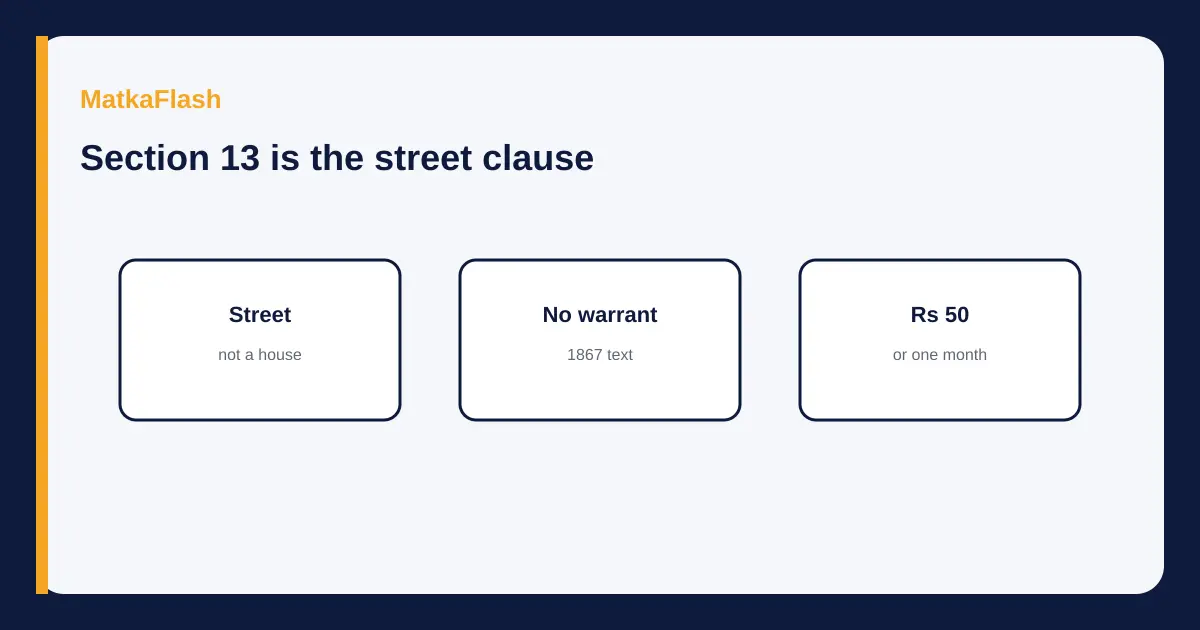
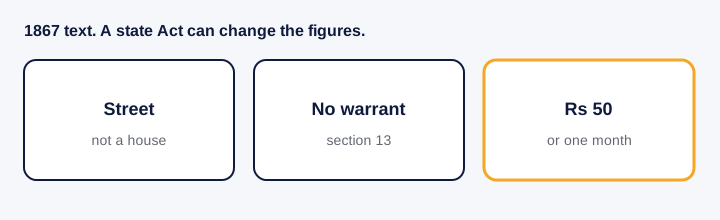
In the 1867 text, police may arrest without warrant for street gambling that is not mere skill. The fine named there is fifty rupees, or jail of one month. States can amend that.
Key facts
- The India Code PDF of Act 3 of 1867 lets a police officer apprehend without warrant under section 13.
- The person described is found playing for money or other valuable thing, with cards, dice, counters or other instruments, at a game that is not mere skill, in a public street, place or thoroughfare within the limits the section names.
- The same text sets a fine not exceeding fifty rupees, or simple or rigorous imprisonment not exceeding one calendar month.
- Police may seize instruments of gaming. A magistrate may order them destroyed on conviction.
- Section 12 says the foregoing provisions do not apply to a game of mere skill. That sentence does not decide that matka is mere skill.
This page is not legal advice. It describes the India Code copy of the Public Gambling Act, 1867, opened on 11 Nov 2026, and one newspaper report. State amendments can change the penalty. It does not say whether any person is guilty.
Contents
Section 13 of the Public Gambling Act, 1867 is the street clause. In the India Code copy opened on 11 Nov 2026, a police officer may arrest without warrant a person found gambling for money, with cards, dice or similar instruments, at a game that is not mere skill, in a public street, place or thoroughfare. The original penalty in that copy is a fine not exceeding fifty rupees, or imprisonment not exceeding one calendar month. Many states have their own gambling Acts or later amendments, so the punishment that applies is the text in force where the case is registered.
| Section | Who | Maximum in that copy |
|---|---|---|
| 3 | Owner, occupier, keeper, manager, or a person who advances money for a common gaming-house | Fine not exceeding ₹200, or imprisonment not exceeding three months |
| 4 | Found playing or present for gaming in such a house | Fine not exceeding ₹100, or imprisonment not exceeding one month |
| 13 | Found playing for money in a public street, place or thoroughfare, at a game that is not mere skill | Fine not exceeding ₹50, or imprisonment not exceeding one calendar month |
| 12 | A game of mere skill, wherever played | The foregoing provisions are not to be applied. The Act does not list matka as mere skill |
What does section 13 say?
The heading in the India Code PDF is 'Gaming and setting birds and animals to fight in public streets.' A police officer may apprehend without warrant any person found playing for money or other valuable thing with cards, dice, counters or other instruments of gaming, used in playing any game not being a game of mere skill, in any public street, place or thoroughfare situated within the limits aforesaid. The same power covers a person setting birds or animals to fight there, and a person present aiding that fighting. The person apprehended shall be brought without delay before a magistrate.
The penalty sentence follows at once: a fine not exceeding fifty rupees, or imprisonment, either simple or rigorous, for any term not exceeding one calendar month. The officer may seize instruments of gaming found in that public place or on the person arrested. The magistrate may, on conviction, order those instruments destroyed. 'Within the limits aforesaid' points back to the places the Act has been extended to. The preamble and section 2 of the same PDF are about named territories and extension by notification. This page does not treat fifty rupees as the fine in every district in 2026.
Is section 13 bailable or non-bailable?
The section, as printed in that PDF, does not use the words bailable or non-bailable. This page did not open the First Schedule of the Bharatiya Nagarik Suraksha Sanhita, so it does not classify the offence from that schedule. A state amendment that raises the maximum jail term can change how a court treats bail. The practical step is to read the section number written on the FIR and ask a lawyer who has the local Act. Guessing 'it is always bailable' from the 1867 maximum would ignore those amendments.
How is section 13 different from sections 3 and 4?
Sections 3 and 4 are about a common gaming-house. Section 3, in the same PDF, reaches the owner or occupier who opens, keeps or uses the place as a common gaming-house, a person who knowingly permits that, a manager or assistant, and a person who advances money for gaming with people who frequent it. The maximum there is a fine not exceeding two hundred rupees, or imprisonment not exceeding three months. Section 4 reaches a person found playing or present for gaming in such a house: a fine not exceeding one hundred rupees, or imprisonment not exceeding one month. A person found there during gaming is presumed, until the contrary is proved, to have been there for gaming.
Section 13 is the public street, place or thoroughfare, not the house. Section 12 says nothing in the foregoing provisions shall be held to apply to any game of mere skill wherever played. That exception is real, and it is not a finding that a matka draw is mere skill. The legal guide keeps the 1867 Act, state laws and the 2025 online Act apart.
Do states use this same fine?
This page did not open amended copies for Uttar Pradesh, Punjab or Madhya Pradesh, so it quotes no replacement fine. Maharashtra uses its own statute. The Maharashtra guide quotes sections 4, 5 and 12A of that Act from the state print. Online money games are a different instrument: the 2025 Act guide is the one for offering and advertising those games.
Dainik Bhaskar reported that on 2 Nov 2026 Vikasnagar police registered case 345/2026 under section 13, after a tip about mobile satta. The paper said ₹790 and a pocket diary were seized. This page does not name the person, and a registered case is not a conviction. Words on a slip, such as those in the glossary, are names for a recorded line. They are not a defence or a charge.
What if police call you or arrest you?
Read the section on the paper, and get a lawyer. NALSA's FAQ, opened on 11 Nov 2026, says a person arrested or called in for questioning can ask for free legal aid. Apply at the District Legal Services Authority front office or on nalsa.gov.in. The FAQ says aid is for people who qualify. It is not a promise that every reader qualifies.
- Open the India Code PDF of the Public Gambling Act, 1867, and read sections 3, 4, 12 and 13 yourself.
- Ask which state's text the police are using. Do not assume the 1867 fine is the one on your FIR.
- If you are arrested or called in, ask the District Legal Services Authority, or a lawyer, before you explain the facts.
- Do not treat a news report of a section 13 case as a judgment.
Common questions
What is the punishment under section 13 of the Public Gambling Act?
In the India Code copy of the 1867 Act, a fine not exceeding fifty rupees, or imprisonment, simple or rigorous, not exceeding one calendar month. A state amendment or a state Act can set a different figure. This page did not collect those later figures.
Is section 13 bailable or non-bailable?
The 1867 text does not say. This page did not classify it under the BNSS schedule. Ask a lawyer with the section written on the FIR.
What is the difference between section 13 and sections 3 and 4?
Sections 3 and 4 are about a common gaming-house: the keeper, and a person found inside. Section 13 is about play for money in a public street, place or thoroughfare. The maxima in the 1867 copy are ₹200 or three months, ₹100 or one month, and ₹50 or one month.
धारा 13 जुआ अधिनियम की सजा क्या है?
1867 की इंडिया कोड प्रति में जुर्माना पचास रुपये से अनधिक, या एक कैलेंडर महीने से अनधिक कारावास। राज्य का बाद का कानून यह आँकड़ा बदल सकता है।
Does section 12 make matka a game of mere skill?
No. Section 12 says the foregoing provisions do not apply to a game of mere skill. It does not name matka, and it does not decide that a matka draw is mere skill.
Sources
- India Code, The Public Gambling Act, 1867, Act 3 of 1867, PDF, opened 11 Nov 2026indiacode.nic.in
- Dainik Bhaskar, Vikasnagar mobile-satta report, case dated 2 Nov 2026bhaskar.com
- National Legal Services Authority, FAQs, including legal aid after arrestnalsa.gov.in
- Directorate General of Health Services, National Mental Health Programmedghs.mohfw.gov.in
Keep reading
 LegalIs satta matka legal in India?Gambling punishment in India depends on the statute and the state. The opened penalties, including BNS section 112, are set out here. Not legal advice.9 min read
 LegalWhat the Online Gaming Act, 2025 bansWhat the Promotion and Regulation of Online Gaming Act, 2025 bans, its penalties, the 2026 Rules and what it means for satta apps. Not legal advice.9 min read
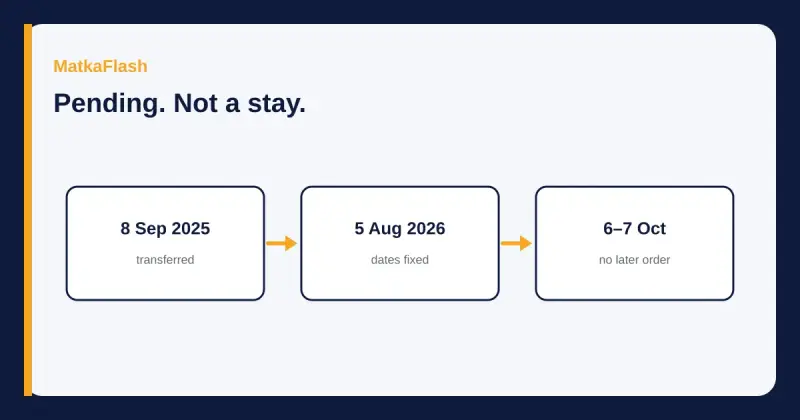 LegalWhere the Online Gaming Act case standsWhere the Supreme Court challenge to the Online Gaming Act, 2025 stands: the transfer, the 5 Aug 2026 order, and why no later date is confirmed.8 min read
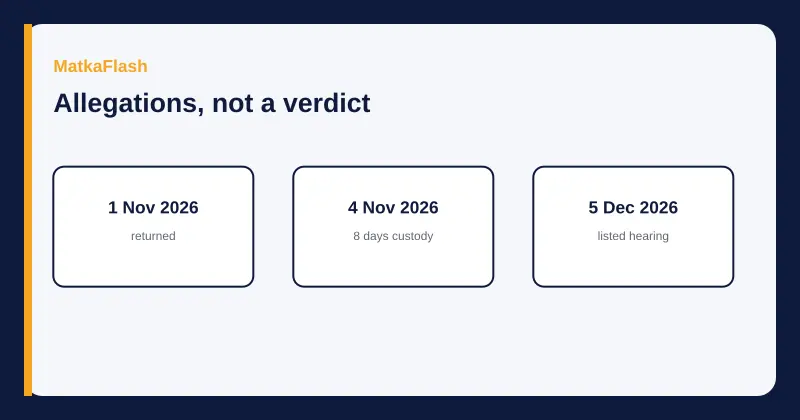 LegalMahadev betting app case: where it standsWhat newspapers reported in November 2026 on the Mahadev app case: custody, extradition and the 5 Dec hearing. Allegations, not a verdict.9 min read