Legal
Is satta matka legal in India?
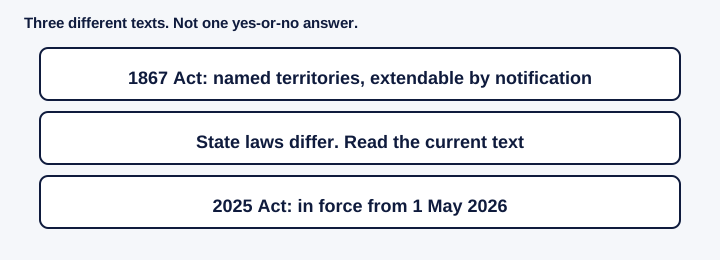
The statutes do not fit in one word. This page sets out what the texts actually say, and where they stop.
Key points
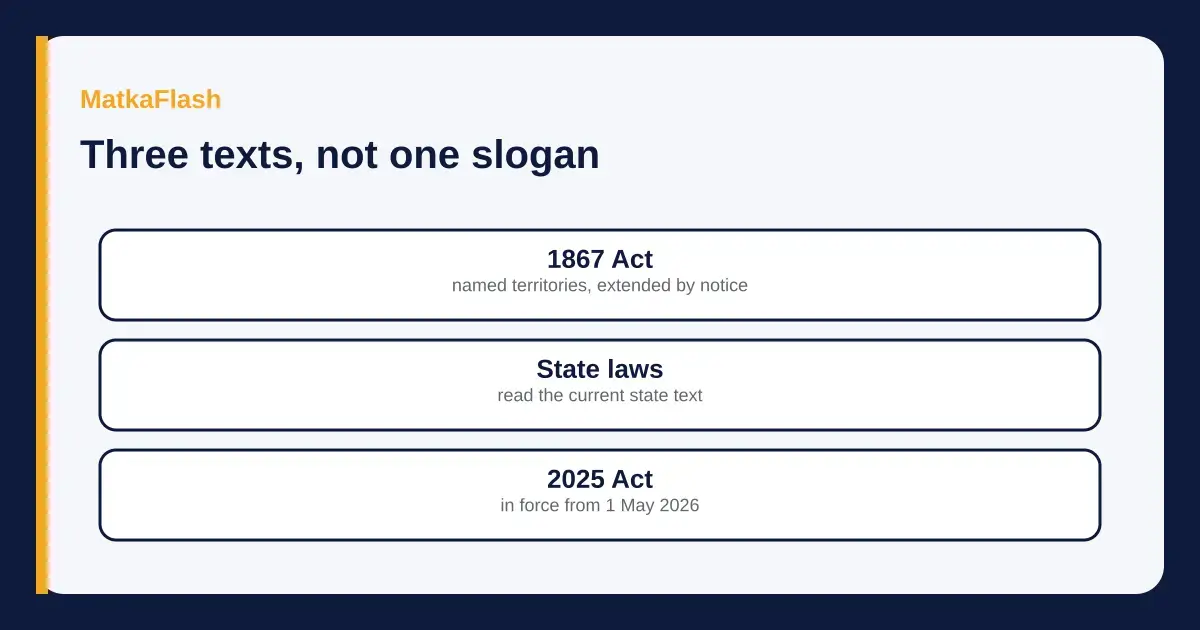
- The 1867 Act's preamble names particular territories. Section 2 is about extension by notification.
- A newspaper calling the game illegal is the newspaper's summary, not the Act's text.
- Article 246 splits Union, State and Concurrent lists. This page does not quote a list entry it could not read.
- The 2025 Act defines online money games of skill or chance. It came into force on 1 May 2026.
- A 1967 rummy judgment is about rummy. It does not decide a matka draw.
This page is not legal advice. It describes documents opened on 7 November 2026 and checked again on 10 November 2026. It does not say whether any person, stake, or state is inside the law.
Contents
People want one word: legal, or illegal. The opened texts refuse that word. The penalties they do set are in the table. Ask a lawyer about your own conduct. Nothing here is that advice.
| Text | What it says in the copy that was opened | Where it was read |
|---|---|---|
| Public Gambling Act, 1867 | Named territories. Most sections extend by notification. Keeper: fine up to 200 rupees or jail up to three months. Person found gaming: fine up to 100 rupees or jail up to one month. | India Code PDF |
| Constitution, Article 246 | Union, State and Concurrent lists. State List items did not extract, so no entry number is quoted. | Legislative Department PDF |
| Indian Express, 15 Oct 2018 | Calls the game illegal via the 1867 Act. A caption calls gambling a state subject. Both lines are news summary. | Express article |
| Online Gaming Act, 2025 | Offering or facilitating: up to three years or ₹1 crore, or both, in the PIB note of 30 Apr 2026. Advertising: up to two years or ₹50 lakh, or both. In force 1 May 2026. | PIB note and MeitY notice |
| Maharashtra Act, sections 4 and 5 | Section 4, keeping a common gaming-house: up to two years, minimum three months and ₹500 on a first offence. Section 5, found gaming there: up to six months, minimum one month and ₹200. | State print, 28 Jan 2019 |
| Satyanarayana, 22 Nov 1967 | Rummy is mainly a game of skill. The case is not a matka draw. | Supreme Court PDF |
The 1867 Act is not a modern national code
The India Code copy is Act No. 3 of 1867, dated 25 January 1867. The preamble names the United Provinces, East Punjab, Delhi and the Central Provinces. A footnote lists later extensions, including Madhya Pradesh, Punjab and Uttar Pradesh. That is a warning against treating one penalty figure as the rule in every district.
Section 1 defines a common gaming-house as a place where instruments of gaming are kept for someone's profit. Section 2 lets a State Government extend most other sections to a city, town or railway station by a notification in three successive Gazette issues. Section 3, in the opened copy, is a fine not exceeding two hundred rupees or imprisonment not exceeding three months for the keeper. Section 4 is a fine not exceeding one hundred rupees or imprisonment not exceeding one month for a person found gaming there. The 15 October 2018 Express article calls this Act the reason the game is illegal and offers its own penalty summary. This page does not repeat that summary, because it does not match sections 3 and 4. Check whether a later state law has replaced them where you are.
A state subject, said carefully
The Legislative Department PDF includes Article 246, which splits law-making across the Union List, the State List and the Concurrent List in the Seventh Schedule. The item-by-item State List text did not extract, so this page does not quote an entry number. The 2018 Express caption says gambling has constitutionally been a state subject. That is the paper's caption. It is a reason to read the current state Act, not a reason to invent its sections.
State Acts differ. Maharashtra's sections 4 and 5 are in the table, and the Maharashtra guide quotes the 2019 print. Other state Acts were not opened. The Mahadev case guide is a news explainer, not a penalty table.
The 2025 Act, including what is not yet claimed
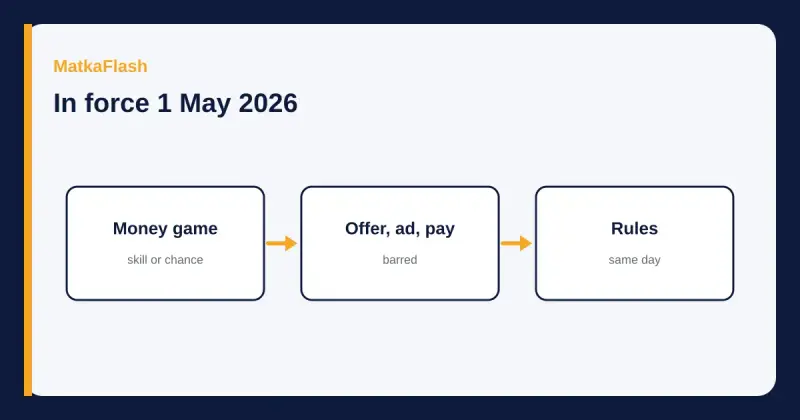
The gazette copy is the Promotion and Regulation of Online Gaming Act, 2025, Gazette of India Extraordinary, Part II, Section 1, No. 37, New Delhi, 22 August 2025. Section 1(2) extends it to the whole of India and to a service offered in India or operated from outside. Section 1(3) says it begins on a date notified in the Official Gazette. That notice was opened on 9 November 2026. It is S.O. 1994(E), New Delhi, 22 Apr 2026, and it appoints 1 May 2026. The Promotion and Regulation of Online Gaming Rules, 2026, G.S.R. 303(E), of the same day, come into force on 1 May 2026. The Act explainer stays with those notices.
Section 2(g) covers an online game of skill, chance, or both when the user pays fees or stakes in expectation of monetary enrichment, and it excludes e-sports. The ban does not wait on a skill argument. Sections 5, 6 and 7 prohibit offering the game, advertising it, and helping the payment. Section 9 is the penalty section: up to three years or one crore rupees, or both, for offering contrary to section 5, and up to two years or fifty lakh rupees for an advertisement contrary to section 6. A repeat conviction is punished more heavily. Section 10 makes offences under sections 5 and 7 cognizable and non-bailable. Section 14 allows blocking under the Information Technology Act's section 69A procedure. Section 18 says this Act is in addition to other law and overrides it where they clash.
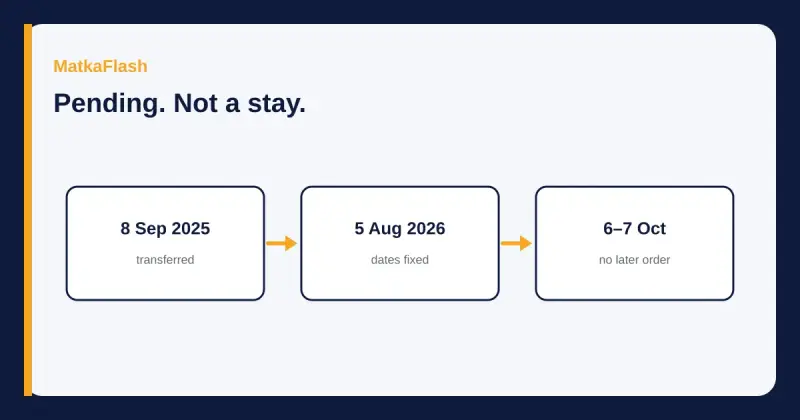
Those sentences are about online money games as the Act defines them. They are not a finding that a particular street draw, a particular website, or a particular reader is guilty of an offence. On 8 Sep 2025 the Supreme Court transferred High Court challenges to itself. On 5 Aug 2026 it posted that batch, including T.C.(C) No. 133/2025, Head Digital Works against the Union of India, for final hearing on 6 and 7 Oct 2026, and it did not stay the Act. No later order was found on 9 Nov 2026. The case-status guide sets out those orders. Guilt is still for a court. This site does not offer a game, take a stake, or advertise a number to play. The editorial guide says what the desk does instead.
A skill case that is not a matka case
State of Andhra Pradesh v. K. Satyanarayana was decided on 22 November 1967 and is reported as 1968 AIR 825. The Court said rummy is mainly and preponderantly a game of skill, unlike the three-card game, because the fall of the cards has to be remembered and the hand has to be built. The case was a rummy club under the Hyderabad Gambling Act. Using that sentence to license or ban matka would misuse the judgment. A published matka number is not a hand of rummy.
The history guide stays with two newspaper accounts of how the game was described, and it points back here whenever those accounts call the game illegal. The pros and cons treats legal risk as one of the costs, without turning that cost into a verdict.
Common questions
Is satta matka legal in India?
Not in one word. The 1867 Act's preamble names particular territories and state laws differ. The 2025 Act is in force from 1 May 2026 for online money games, and a challenge to it is pending.
Does the 1867 Act set a fine of a few hundred rupees everywhere?
The opened copy sets section 3 at a fine not exceeding two hundred rupees or imprisonment not exceeding three months, and section 4 at one hundred rupees or one month. Later state laws can differ. A newspaper summary was not used.
Is the 2025 online gaming Act in force?
Yes, from 1 May 2026. Section 1(3) needed a gazette date. S.O. 1994(E) of 22 Apr 2026 is that notice. A pending Supreme Court case, unread as a stay on 5 Aug 2026, does not undo it.
Satta khelna apradh hai kya?
Not in one sentence, and not 'no penalty'. The 1867 copy punishes a gaming-house keeper and a person found gaming there, inside the territories and extensions it describes. Maharashtra's sections 4 and 5 set jail and fines for a common gaming-house. The 2025 Act penalises offering and advertising an online money game. Which text applies is a lawyer's question, not this page's.
What is section 13 of the Public Gambling Act, 1867?
In the India Code text, section 13 lets a police officer apprehend without warrant a person found playing for money, in a public street or place within the limits the section refers to, at a game that is not mere skill. The fine named there does not exceed fifty rupees, or imprisonment not exceeding one month. Section 12 says the foregoing provisions do not apply to a game of mere skill. That sentence does not decide that matka is mere skill.
What is the punishment for gambling in India?
There is no single national figure. In the 1867 copy, section 3 is a fine not exceeding ₹200 or jail not exceeding three months for the keeper, and section 4 is ₹100 or one month for a person found gaming. Maharashtra's print sets higher minimums in its own sections 4 and 5. The PIB note of 30 Apr 2026 states the 2025 Act's online offering and advertising penalties. Another state's Act can differ.
Sources
- India Code, The Public Gambling Act, 1867, Act 3 of 1867, PDFindiacode.nic.in
- Legislative Department, The Constitution of India, PDF including Article 246legislative.gov.in
- Ministry of Electronics and Information Technology, Gazette PDF of the Promotion and Regulation of Online Gaming Act, 2025meity.gov.in
- Supreme Court of India, State of Andhra Pradesh v. K. Satyanarayana, judgment dated 22 November 1967, 1968 AIR 825api.sci.gov.in
- The Indian Express, What is Satta Matka, 15 October 2018indianexpress.com
- MeitY, S.O. 1994(E), 22 Apr 2026, commencement on 1 May 2026meity.gov.in
- Supreme Court of India, order of 5 Aug 2026 in the Online Gaming Act batchapi.sci.gov.in
- Government of Maharashtra, Law and Judiciary Department, Bombay Act IV of 1887, as modified up to 28 January 2019cdnbbsr.s3waas.gov.in
- Directorate General of Health Services, National Mental Health Programmedghs.mohfw.gov.in
Keep reading
 LegalWhat the Online Gaming Act, 2025 bansWhat the Promotion and Regulation of Online Gaming Act, 2025 bans, its penalties, the 2026 Rules and what it means for satta apps. Not legal advice.9 min read
 LegalWhere the Online Gaming Act case standsWhere the Supreme Court challenge to the Online Gaming Act, 2025 stands: the transfer, the 5 Aug 2026 order, and why no later date is confirmed.8 min read
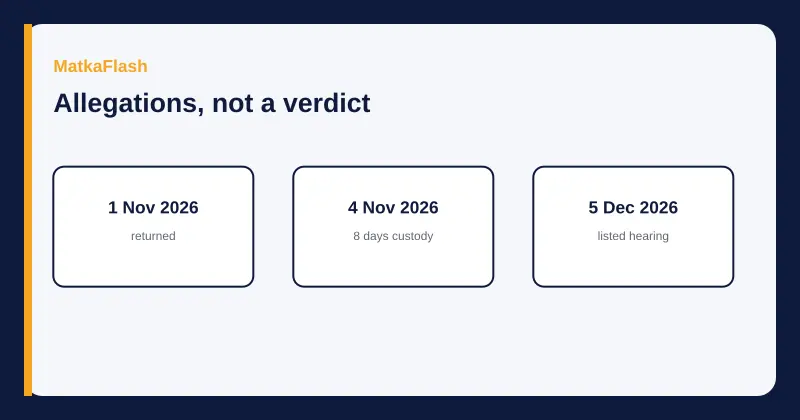 LegalMahadev betting app case: where it standsWhat newspapers reported in November 2026 on the Mahadev app case: custody, extradition and the 5 Dec hearing. Allegations, not a verdict.9 min read
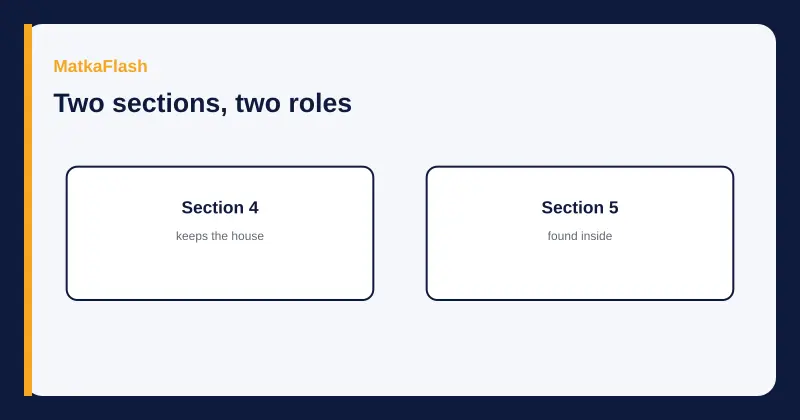 LegalWhat the Maharashtra Prevention of Gambling Act saysSections 4, 5 and 12A of the Maharashtra Prevention of Gambling Act, from the state print, plus two dated raids. Not legal advice.9 min read