Legal
What BNS section 112 says about petty organised crime
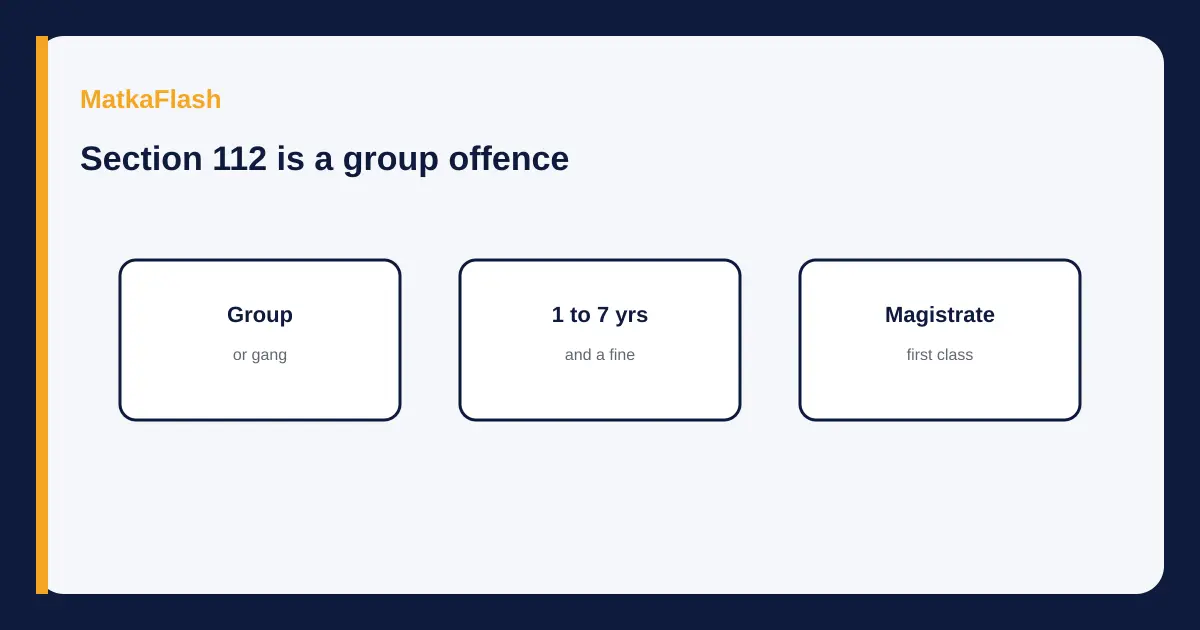
Section 112 is written for a member of a group or gang. The penalty in the text is one to seven years, and a fine.
Key facts
- Section 112(1) names theft, snatching, cheating, unauthorised ticket selling, unauthorised betting or gambling, selling exam papers, and similar acts, when a member of a group or gang commits them.
- Section 112(2) sets imprisonment of not less than one year, which may extend to seven years, and a fine.
- The NCRB BNSS First Schedule classifies it as cognizable, non-bailable, and triable by a Magistrate of the first class.
- NCRB lists section 112 as a new section, with no direct IPC equivalent.
- A published result, such as a Kalyan line, is a record. It is not the unauthorised betting the section names.
This page is not legal advice. It describes the India Code text of section 112, the PIB handbook wording, the NCRB schedule, and one newspaper report, all as given in the sources opened for 12 Nov 2026. It does not say that any reader has committed an offence.
Contents
Section 112 of the Bharatiya Nyaya Sanhita, 2023 covers petty organised crime: a member of a group or gang who, alone or with others, commits theft, cheating, unauthorised betting or gambling, or a similar act. Section 112(2) sets one to seven years in prison, and a fine. The NCRB schedule calls it cognizable and non-bailable.
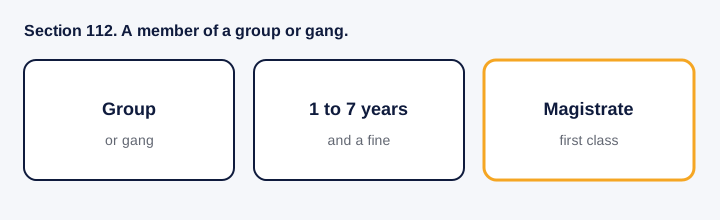
| Point | What the source says |
|---|---|
| Offence | Petty organised crime by a member of a group or gang |
| Acts named | Theft, snatching, cheating, unauthorised tickets, unauthorised betting or gambling, exam papers, or a similar act |
| Punishment | Imprisonment of at least 1 year, up to 7 years, and a fine |
| Cognizable | Yes, on the NCRB BNSS First Schedule |
| Bailable | Non-bailable, on that schedule |
| Court | Magistrate of the first class |
What does section 112 BNS say?
The India Code text, read for this page, defines petty organised crime in those words. The Explanation on theft includes trick theft, theft from a vehicle, a dwelling or business premises, cargo theft, pick pocketing, card skimming, shoplifting and theft of an ATM. Unauthorised betting or gambling is one item in the list, beside theft and cheating. It is not a separate code of its own. A person playing alone is not the person the opening words describe. The section is written for members of a group or gang.
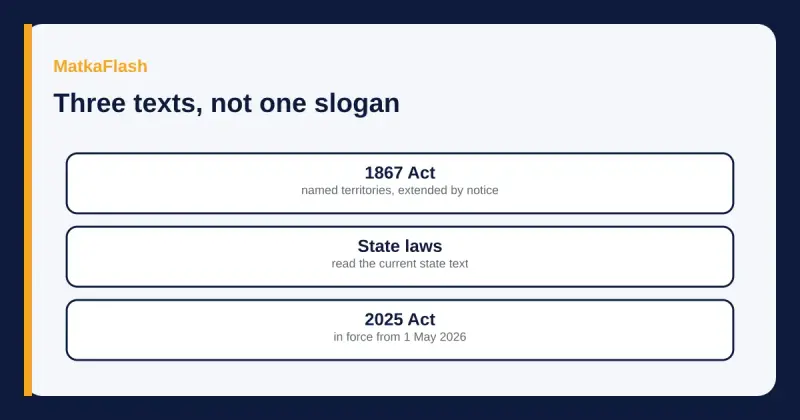
State gambling Acts can still be cited in the same case. The Public Gambling Act guide stays with section 13 of the 1867 Act. The Maharashtra guide quotes that state's print. The legal guide sets those texts side by side. A Kalyan result on this site is a declared line, not a betting instruction.
Is section 112 bailable?
The NCRB page headed Classification of offences, BNSS First Schedule, lists the row in these words: 112, Petty Organised crime, imprisonment for not less than 1 year but which may extend to 7 years and fine, cognizable, non-bailable, Magistrate of the first class. That is the classification used here. This page does not invent a different bail rule. NCRB's correspondence table lists 112 as a new section, so this page says there is no direct IPC equivalent only with that NCRB attribution.
Section 111 and section 112
The PIB handbook on the Bharatiya Nyaya Sanhita describes section 111, organised crime, with a minimum of five years, and up to life imprisonment in the words it uses for 'any other case'. Section 112 is the petty organised crime clause, with the one-to-seven-year range above. This page does not copy the rest of section 111. The difference that matters for a reader is the label and that minimum: five years in the handbook's 'any other case' for section 111, and one year at the floor of section 112(2).
How police have used it in a betting case
The Times of India, Indore, on 24 Oct 2026, reported a Crime Branch case against two men alleged to be running a betting app network. The paper said the case was registered under sections 3 and 4 of the Public Gambling Act, section 112 of the BNS, and section 66 of the Information Technology Act. This page does not name them. An arrest and a registered case are allegations, not convictions. The Reddy Anna guide collects other 2026 reports in the same spirit. Words in the glossary are definitions of chart terms, not elements of an offence.
What to do if you are named in a notice
Read the sections written on the paper, and speak to a lawyer about those sections. This page cannot tell you whether section 112 fits the facts of a case. Do not treat a chat message that offers to 'close the case' for a fee as the police. Asking a lawyer is the step. Paying a stranger is not.
- Read section 112 on India Code, including the list of acts and the Explanation on theft.
- Read section 112(2) for the one-year minimum, the seven-year maximum, and the fine.
- Read the NCRB BNSS schedule row for cognizable, non-bailable, and the court.
- If a paper names you, take that paper to a lawyer. Do not pay a caller who offers to settle it.
Common questions
Is section 112 BNS bailable or not?
The NCRB BNSS First Schedule classifies petty organised crime under section 112 as non-bailable. It also lists the offence as cognizable and triable by a Magistrate of the first class.
Which court tries section 112 BNS?
The same NCRB schedule says a Magistrate of the first class. This page does not name a different court.
What is petty organised crime?
In section 112(1), it is a member of a group or gang committing, alone or together, theft, snatching, cheating, unauthorised ticket selling, unauthorised betting or gambling, selling exam papers, or a similar criminal act.
What is the punishment under section 112(2)?
Imprisonment of not less than one year, which may extend to seven years, and a fine. That is the sentence in the section, not a prediction of what a court will impose.
Does section 112 replace the Public Gambling Act?
The Indore report of 24 Oct 2026 described a case that cited the 1867 Act's sections 3 and 4 together with section 112 and section 66 of the IT Act. This page does not treat one section as cancelling the others.
Sources
- India Code, Bharatiya Nyaya Sanhita, 2023, section 112indiacode.nic.in
- Press Information Bureau, Bharatiya Nyaya Sanhita handbook, May 2024static.pib.gov.in
- National Crime Records Bureau, classification of offences, BNSS First Schedulencrb.gov.in
- The Times of India, Indore, 24 Oct 2026, betting-app case citing section 112timesofindia.indiatimes.com
- Directorate General of Health Services, National Mental Health Programmedghs.mohfw.gov.in
Keep reading
 LegalIs satta matka legal in India?Gambling punishment in India depends on the statute and the state. The opened penalties, including BNS section 112, are set out here. Not legal advice.9 min read
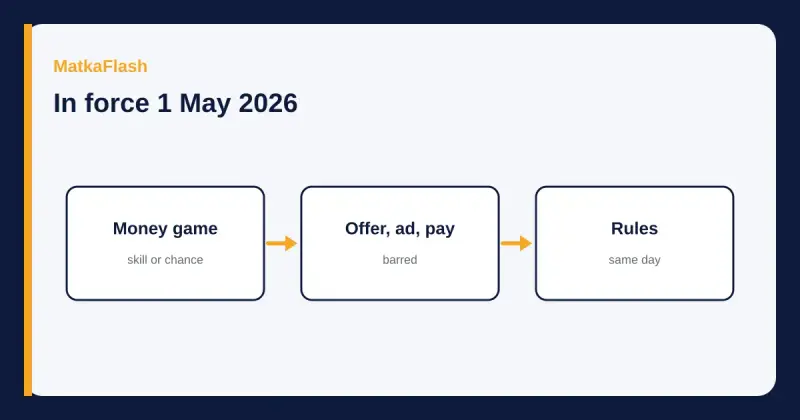 LegalWhat the Online Gaming Act, 2025 bansWhat the Promotion and Regulation of Online Gaming Act, 2025 bans, its penalties, the 2026 Rules and what it means for satta apps. Not legal advice.9 min read
 LegalWhere the Online Gaming Act case standsWhere the Supreme Court challenge to the Online Gaming Act, 2025 stands: the transfer, the 5 Aug 2026 order, and why no later date is confirmed.8 min read
 LegalMahadev betting app case: where it standsWhat newspapers reported in November 2026 on the Mahadev app case: custody, extradition and the 5 Dec hearing. Allegations, not a verdict.9 min read