Safety
Fake recovery agents and the second payment
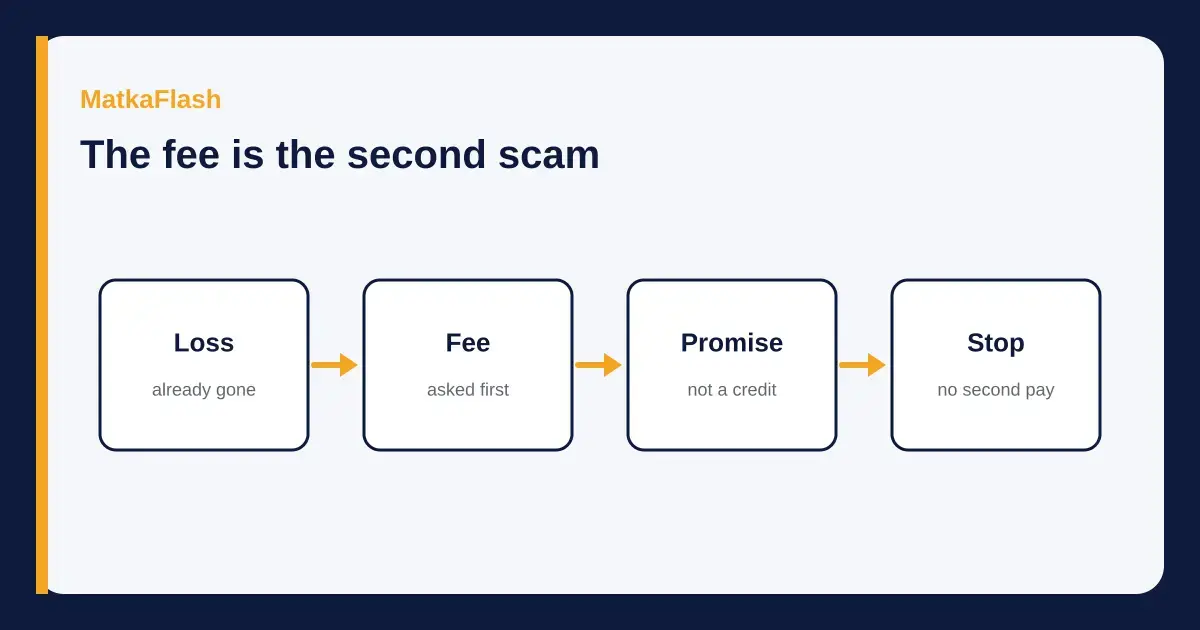
After a loss, a stranger may offer to get the money back for a fee. The fee is the business. The refund is the bait.
Key points
- An unsolicited offer to recover money, with a fee paid first, is a second approach.
- The Hindu reported on 25 August 2024 that Kerala police said official agencies do not charge a fee to recover stolen funds.
- A lawyer or a firm you sought out is not the same thing as a caller who found you.
- Do not hand over remote access, one-time passwords, or the complaint acknowledgement.
- Reporting stays on 1930 or the portal you type. Emotional support is Tele-MANAS, a different line.
This page does not say every lawyer or recovery professional is a fraud, and it does not say honest work is free. It is about unsolicited guaranteed recovery and impersonation.
Contents
The first scam takes the money. The second scam arrives because the first one worked. Someone has your number, knows you are upset, and offers a service: we will get it back. The fix-game guide stops at the original fee. This page starts at the offer that follows. It does not list agents, and it does not sell a recovery of its own.
| What they say | The question | A careful reading |
|---|---|---|
| We recover 100 percent | Who is 'we', and who asked for you? | Unsolicited certainty is the pitch |
| Pay a registration fee, GST extra | Did you look them up, or did they call? | The Hindu's report of a police warning describes this shape |
| Refund in 48 hours | Is that a contract you can read? | A short window plus a fee is pressure |
| We are the legal authority | Does the name exist on a site you typed? | A similar name is not a badge |
| Share your screen | Why does recovery need your phone? | Access is another theft |
Why might a scam victim receive a money-recovery offer?
Your number is already in a chat that talked about money. Lists of people who paid once are useful to the next caller. The caller does not need a new story. The old loss is the story. Shame makes the offer feel private, which is what the caller wants: no one else hears the fee. You do not have to explain the matka part to recognise the shape. Any loss will do. A matka number in the script only tells you which list they bought.
A quiet week after the first scam is not safety. The second contact can be a call, a voice note, or a message that already knows the amount. Knowing the amount is not proof they are official. The first scammer had the amount too.
Which advance-fee and guaranteed-refund claims are warning signs?
The Hindu, in a report published 25 August 2024 and updated the next morning, described a Kerala police advisory. People who had already lost money to online fraud were getting WhatsApp calls or voice messages from a group calling itself the All India Legal Services Authority. The pitch, as the paper reported it, was that the whole amount would be recovered after the victim paid a registration fee, that the fee would be billed with GST, and that the fee plus the lost funds would be refunded within 48 hours. Police, the paper wrote, said no such organisation is authorised or able to recover money lost in online scams, and that official agencies do not charge fees for recovering stolen funds.
That is one reported shape, not a list of every phrase in use. The reusable signs are the ones in it: they found you, they promised the entire sum, they wanted money first, and they named a short refund. A fee that is a published charge of a lawyer you instructed, with a written scope that does not promise the impossible, is a different arrangement. This page cannot draw that contract for you. It can say the unsolicited version, with a guarantee and an upfront registration, matches the warning the paper attributed to the police.
How do impersonators misuse police, bank or lawyer identities?
The advisory's example used a legal-sounding name. Other calls use a police rank, a bank fraud desk, or a court. The misuse is the same. The title arrives with the fee, not with a letter you can check on a site you typed. A similar spelling is enough for a hurried reader. Ask for the name in writing and then search it yourself. Do not let them stay on the line while you 'verify', because the person still talking will supply the verification.
A real police officer can tell you to dial 1930 or to come to a station. The portal home page already says a victim of financial cyber fraud can dial 1930. An officer who instead sends a payment link has left that instruction. Hang up and dial the number you read on the portal, not the number on the screen they shared.
What information and device access should you never hand over?
Do not share a one-time password, a card number, or remote control of the phone. Recovery of a past transfer does not require them to operate your device. Do not send the acknowledgement number of a complaint you already filed. That number is how a stranger pretends to be inside your report. Do not install an app so they can 'see the transaction'. The app-risk guide is the reason an unknown app is a stop, not a tool.
Do not hand over photographs of identity documents to a caller. If a bank you already use asks for something, it asks inside its own app or branch, not in a new chat that began with your loss.
How can you independently verify a claimed official contact?
Type the address. For the national portal, that is https://www.cybercrime.gov.in/, which on 9 November 2026 told financial-cyber-fraud victims to dial 1930. Call 1930 from that reading, not from a contact card. If the caller names a state police unit, find that unit's published number on a site you opened, then call it and describe the offer without paying first. If they name a lawyer, you may call the number on a bar directory you trust, not the number in the message.
Verification is a new call you place. It is not a code they text you, and it is not a website they send. The status guide says the same about tracking links. A status check and a recovery pitch fail in the same way when the address arrives in the chat.
What evidence should you keep if someone targets you again?
Keep the new messages, the number, the fee they named, and the name they used. Do not pay in order to 'document' them. A refused demand is still evidence. Store it with the first complaint's acknowledgement if you have one, and tell the channel you already used that a second approach arrived. You do not need a fresh theory of the original matka chat.
Do not send this bundle to MatkaFlash. A results page will not attach it to a case. Sending it here only creates a copy you no longer control.
Where can you seek official reporting and emotional support?
Reporting a financial cyber fraud, including this second approach, is the helpline the portal names: 1930, or the portal you type. The Hindu's report of the Kerala advisory also said the police asked people to report by calling 1930. This website does not add a promise that calling will restore a given transfer. The paper's line that timely reporting increases the chance of recovery is the advisory as they summarised it, not a rate MatkaFlash measured.
If the calls are costing sleep, that is a different number. Tele-MANAS, printed by the Directorate General of Health Services, is 1800-89-14416 or 14416. It is mental health support, not a fraud desk, and not a diagnosis. The harm guide is about signs that staking itself is doing damage. Neither page is a fund-recovery desk. There is no desk of that kind on this site.
Common questions
Are all recovery agents fraudulent?
This page does not say that. It warns against unsolicited guaranteed recovery and against impersonation. A professional you chose, who does not promise the impossible and does not demand secrecy, is a different situation.
The caller knew the exact amount. Are they official?
No. The person who took the money knew the amount. A later caller can buy or share that fact. Official contact is a number you look up, not a number that calls you.
They want GST on a registration fee and promise 48 hours. Is that the police?
That shape matches what The Hindu reported scammers told victims, and what Kerala police said official agencies do not do. Do not pay it.
Can MatkaFlash recover the money?
No. This site publishes results. It does not recover transfers and it does not take a fee to try.
Sources
Keep reading
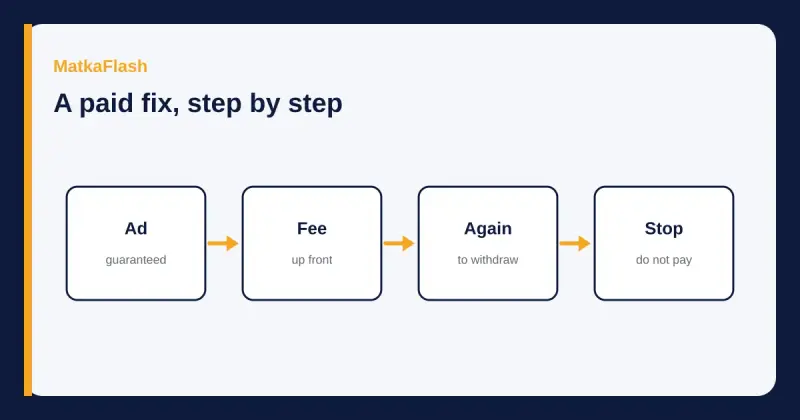 SafetyHow fix-game scams ask for a second feeHow a guaranteed matka number usually turns into an advance fee and a blocked withdrawal, and what to stop doing if you already paid.5 min read
 SafetyHow to spot a fake matka result site or appCopied results, fake live claims, paid groups and APK files. A checklist for leaving, not a list of sites to join.5 min read
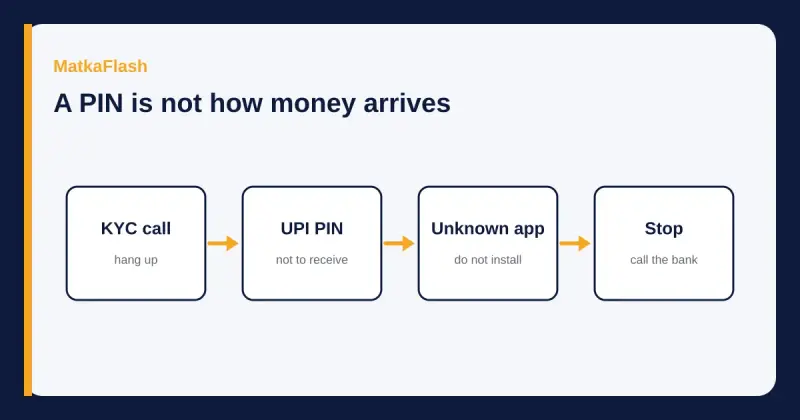 SafetyRisks that follow a betting app and a UPI paymentWhat the RBI's 28 January 2022 note says about KYC calls, unknown apps and a UPI PIN asked in order to receive money.8 min read
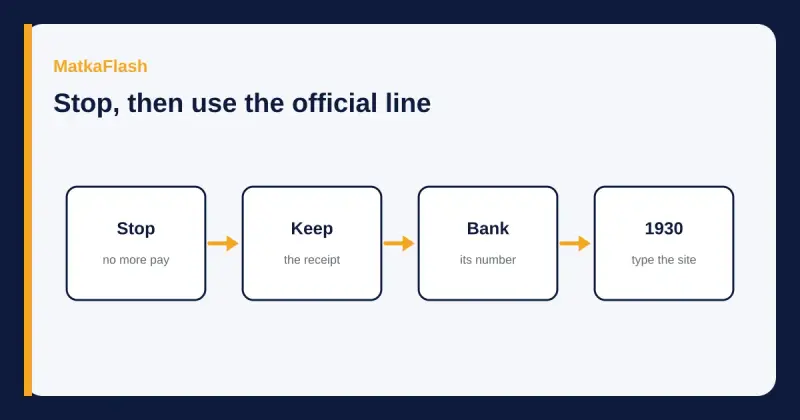 SafetyPaid a matka scammer? Prepare a fraud complaintKeep transaction evidence, contact your bank and find official cyber-fraud reporting channels. No recovery guarantees or further payments.8 min read