Awareness
Pros and cons of satta matka
People name a few advantages. The arithmetic, the legal uncertainty, and the scam risk sit on the other side.
Key points
- The usual 'pros' are claims: a small stake, a moment of hope, a printed payout.
- The payout, if one exists, is written by the operator. It is not a fair coin.
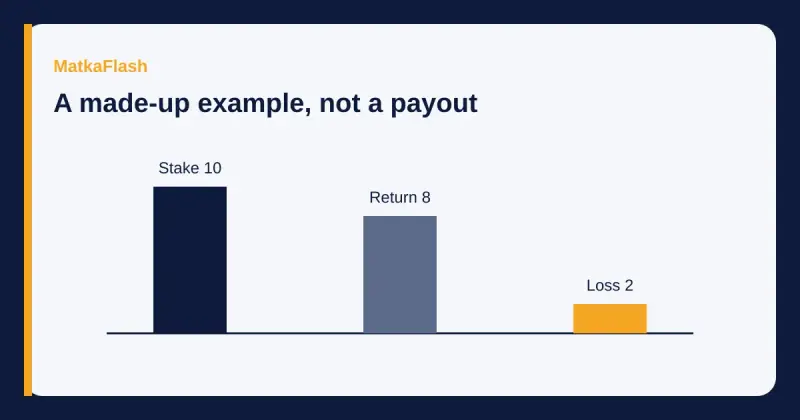
- A labelled hypothetical ticket of 10 that pays 80 on one digit of ten loses 2 on average.
- Debt, chasing, legal uncertainty and scams sit on the other side of the table.
- The practical conclusion is to leave it alone.
The bars below are a made-up example. They are not a matka rate, and this page is not a way to play.
Contents
A honest list of pros and cons does not start by inventing a benefit. It starts with what people say when they defend a stake, and then it asks what that sentence can actually carry. This page does that. It does not explain how to place a stake, which market to choose, or what a book pays. Those are operating instructions, and this site does not publish them.
| What people say | What that claim does not establish |
|---|---|
| The stake can be small | Small losses still add up, and the next stake is often larger |
| It is only entertainment | Entertainment that is priced to lose is an expense, not a hobby with a refund |
| Someone nearby won | A win you hear about is a selected story. The losses are quieter |
| The chart shows a pattern | A chart shows past rows. It does not price the next row |
| Skill can beat it | A published number draw is not a hand of cards you can play better |
The advantages, stated as claims
The first claim is that the amount can be small, so the harm is small. A single small stake can be a small loss. The business does not live on a single stake. It lives on the next one, which is easier to justify because the last one was 'only' small. A stack of small losses is not small. The second claim is entertainment: a few minutes of hope between the open and the close. Hope is real as a feeling. It is not a refund. The minutes are spent waiting on a number someone else will declare.
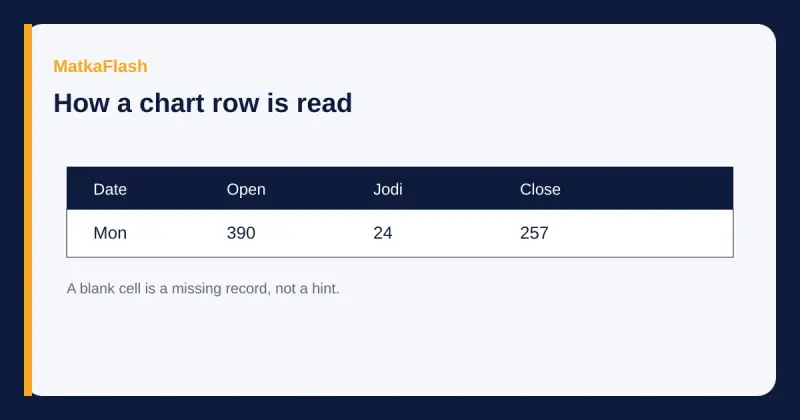
The third claim is that a known person won. A win is possible whenever a payout is larger than the stake and some tickets match. Hearing about the win, and not about the tickets that missed, is the same selected record described in the guessing guide. The fourth claim is that a chart is a pattern a careful reader can use. The chart is a diary. Reading it well means noticing dates, blanks and conflicts. It does not mean extracting a coming pair.
A loss, labelled as imaginary
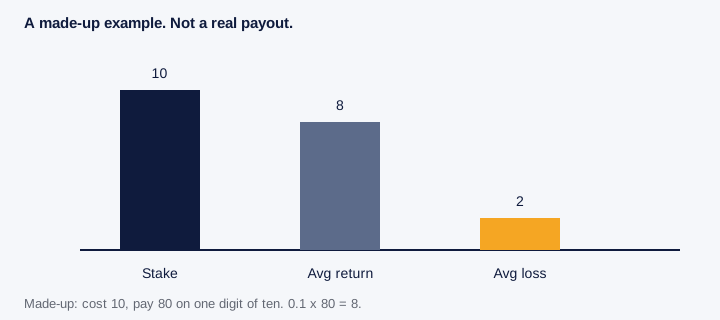
Suppose, only as an imaginary example, that a ticket costs 10 rupees and a printed table pays 80 rupees when one digit from 0 to 9 matches. If each digit were equally likely, the average return would be one tenth of 80, which is 8. The average result of a 10 rupee ticket would be a loss of 2 rupees. The bars draw that sketch: a stake of 10, an average return of 8, an average loss of 2. No matka operator published this table. Do not treat 10 or 80 as a rate. The point of the sketch is the shape. The person who prints the payout chooses numbers that, if the draw is not biased in the player's favour, leave the average ticket short.
Real tables, where they exist, are often less kind than this sketch, because the operator also has costs and a margin. This page will not hunt for a live table and reprint it. Reprinting a payout is an advertisement. The sketch is enough to show why 'someone can win' and 'the average ticket loses' are both true. A person can be the one ticket that matches and the room as a whole can still be down.
The other column
Chasing is the cost that does not appear in the first stake. After a miss, the next stake is framed as the way to repair the miss. The repair stake is a new ticket with the same average shortfall. Debt follows when the money was meant for rent, food, or a payment that has a date. Family arguments follow the secrecy, not just the amount. The help guide lists signs that are reasons to pause. It is not a diagnosis.
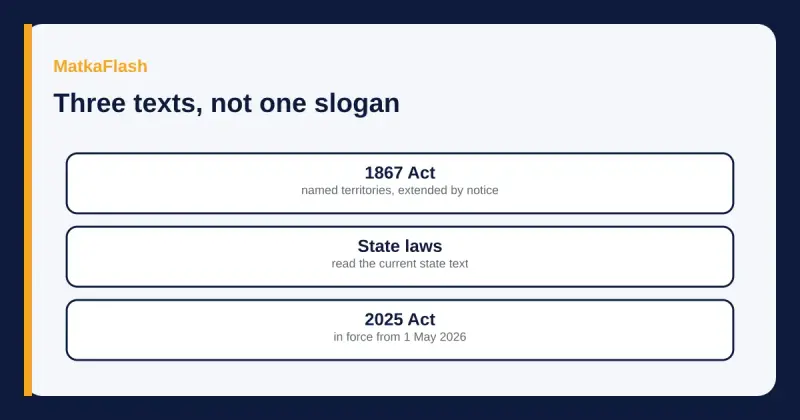
Legal risk is a separate cost, and it is not a number this page can price. The legal guide shows why a slogan is a poor substitute for the 1867 Act, differing state laws, and a 2025 Act that starts only when the Gazette says so. A fine, a case, or a blocked payment is not an entertainment expense you can budget from a chart. Scam risk sits beside it. A person who is already down is the person a 'fixed' number is sold to. That loss is not in the hypothetical 2 rupees. It is the whole of whatever was sent.
A practical conclusion
Put the claimed advantages on one side: a stake that can start small, a feeling of hope, and the possibility that one ticket matches. Put the limits on the other: the average ticket is built to fall short, the wins you hear about are selected, the chart does not price the future, the law is not a slogan, and the fix-game pitch is aimed at the person who wants the loss back. The claimed advantages do not survive that list. The practical step is not a smarter stake. It is not to stake.
Common questions
Is the bar chart a real matka payout?
No. It is a made-up example: a ticket of 10 that pays 80 on one digit out of ten. The average return is 8 and the average loss is 2. No operator published those figures here.
Can a small stake still be harmless?
One small loss can be small. The harm is the next stake, the money that was meant for something else, and the pitch that offers to repair the loss.
Does a chart improve the odds?
No. A chart records past declarations. It does not change the average shortfall of the next ticket.
Does this page recommend a market with better pros?
No. The conclusion is not to stake. There is no recommended market.
Sources
Keep reading
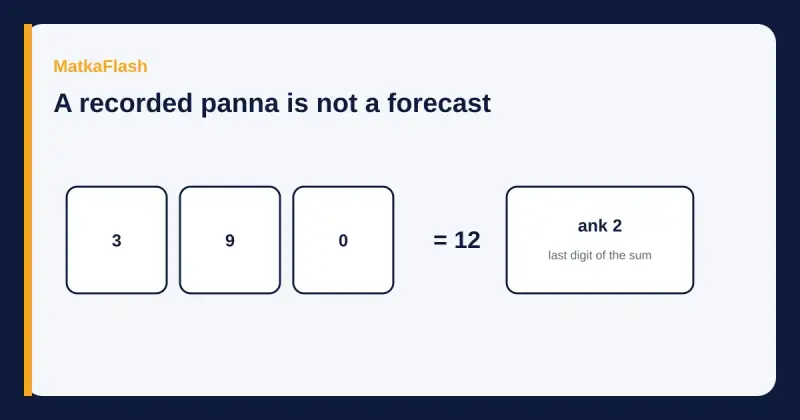 BasicsWhy guessing and fix ank do not workA matka chart records a draw that already happened. Fix ank lists and weekly jodis do not name the next independent draw.6 min read
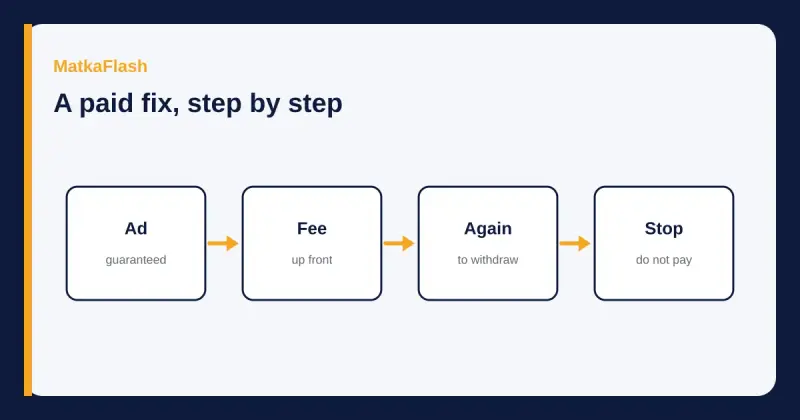 SafetyHow fix-game scams ask for a second feeHow a guaranteed matka number usually turns into an advance fee and a blocked withdrawal, and what to stop doing if you already paid.5 min read
 LegalIs satta matka legal in India?What the 1867 Act, Article 246 and the 2025 online gaming Act actually say. Not a yes, not a no, and not legal advice.9 min read
 BasicsHow to read a jodi or panel chartWhat the date, open panna, jodi and close panna columns record, and why a blank cell is not a forecast.6 min read