Safety
Bank account frozen after a cyber complaint: how to get it reviewed
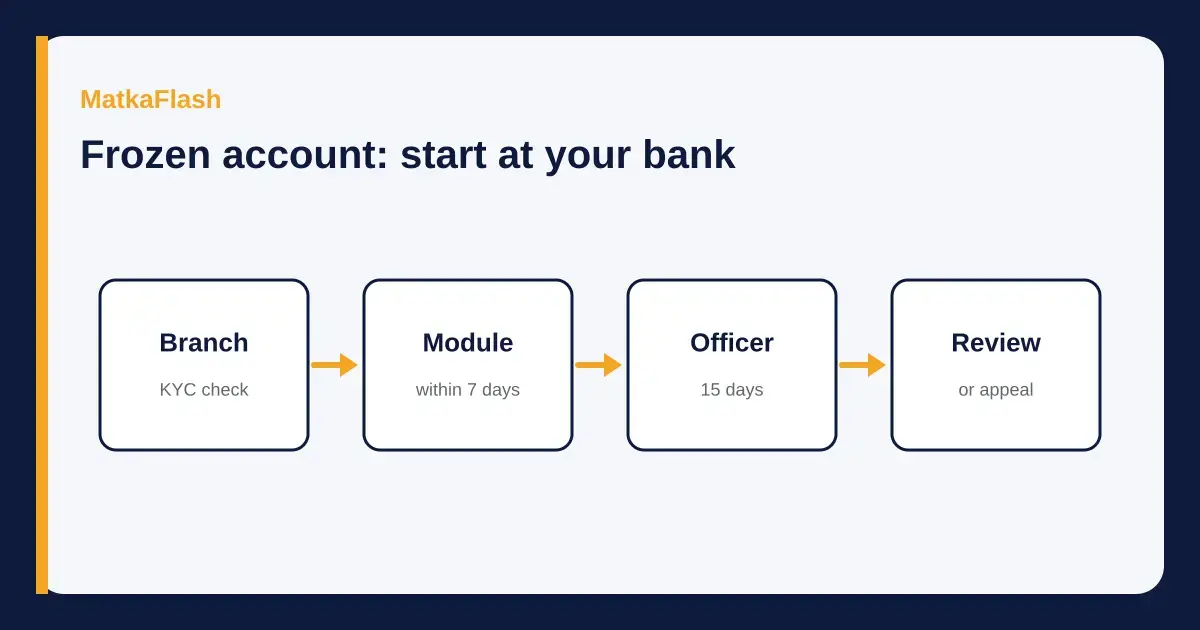
Start at your own bank branch, not with an agent. The MHA procedure gives the bank 7 days to file your grievance and the police 15 days to answer it.
Key facts
- The MHA Standard Operating Procedure for NCRP-CFCFRMS is dated 2 Jan 2026. It covers holds, seizures, grievances and the return of money.
- A Lok Sabha reply of 28 Jul 2026 says the Grievance Redressal Module and the Money Restoration Module have worked since April 2026.
- Under the SOP you go to your bank branch first. The bank should file the grievance within 7 calendar days of your complaint.
- The police officer handling it has 15 calendar days to release the hold or record reasons for keeping it.
- If you disagree, you can ask a District Grievance Officer for review within 15 days, and you can go to a court at any point.
This page is not legal advice. It summarises the Ministry of Home Affairs SOP dated 2 Jan 2026 and a Lok Sabha reply of 28 Jul 2026. Your bank and the investigating officer decide your case, not this site.
Contents
If your bank account was frozen, or an amount was put on hold, after a cyber-crime complaint, go to your own bank branch and ask it to raise a grievance on the national portal. The Ministry of Home Affairs procedure dated 2 Jan 2026 says the bank should file it within 7 calendar days. The police officer then has 15 calendar days to decide. You don't need an agent, and no one can buy you a faster result.
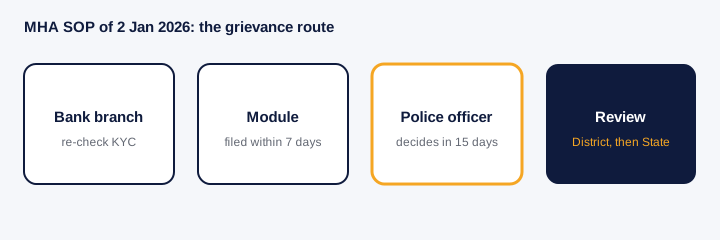
| Step | Who acts | Limit in the SOP |
|---|---|---|
| File the grievance on the module | Your bank, after re-checking KYC | Not beyond 7 calendar days from your complaint |
| Release the hold or give reasons | Investigating officer or police officer | 15 calendar days |
| No answer from the officer | Goes to the District Grievance Officer automatically | After 15 calendar days |
| Ask for a review | You, through the designated bank branch | Within 15 calendar days of the decision |
| Review decision | District Grievance Officer | 15 calendar days |
| Appeal on a seized account | State Grievance Officer | File within 15 days; decision in 15 days |
Why does an account get frozen after a cyber complaint?
When someone reports a financial fraud on 1930 or cybercrime.gov.in, the money trail is followed from bank to bank. If part of that money reached your account, the amount can be put on hold. This is sometimes called a lien. It can happen even if you didn't know where the money came from. A payment from a stranger, a refund from a betting app, or a 'part-time job' credit can all be in the chain. The Economic Times explained on 5 Nov 2026 that a debit freeze stops money going out by ATM, UPI, net banking or card, while money can still come in.
The SOP separates two actions. A hold covers the reported amount only. A seizure, or a suspension of digital banking, covers the whole account, and the SOP says such directions are given under Section 106 of the BNSS or another law in force. Ask your bank which one you have. The answer decides how you appeal. If someone rented your account, the mule account guide explains why I4C warns against it.
What should you do first?
Go to the branch where your account is held, or the office your bank names for these cases. Take your ID, your passbook or statement, and anything that shows why the money came in: an invoice, a salary slip, a chat with a buyer, or a receipt. Ask the branch three things in writing. Is this a hold on an amount, or a seizure of the account? Which police station or officer asked for it? What is the complaint or reference number? Write the answers down and keep copies.
The SOP says banks with branches will ask you to visit so they can re-check your KYC. The bank then does what the SOP calls enhanced due diligence. If it's satisfied, it files your grievance on the Grievance Redressal Module with your explanation attached. Payment banks without branches may use other arrangements. If the branch says it can't file, ask it to give that answer in writing.
What does the police officer do with your grievance?
The grievance goes to the station that asked for the hold. The officer handling the case checks it and can send you a notice to explain the transaction. The SOP says this should preferably be by video conference. You shouldn't be called in person unless it's unavoidable and an FIR or e-FIR has been issued. If the officer is satisfied, they tell the bank to remove the hold within 15 calendar days of getting the grievance. If not, they must record reasons on the module within 15 days, and you should be told by SMS or email.
If the officer doesn't act in 15 days, the module sends the grievance to the District Grievance Officer automatically. The SOP says each state should name a state grievance officer of ADG, IG or DIG rank, and district officers of Additional SP or Deputy SP rank. Your bank should also have its own grievance officers.
What if the decision goes against you?
You can ask for a review within 15 calendar days of being told, through the designated bank branch. The District Grievance Officer then has 15 days to decide. For a seized account or suspended digital banking, the SOP also allows an appeal to the State Grievance Officer within 15 days. And it says you can approach the court with jurisdiction at any time for the account to be released. A lawyer you choose yourself can advise on that step. This page can't.
For holds that were contested through the grievance module, the SOP adds a backstop. If no lawful direction to keep or drop the hold arrives within 90 calendar days of the bank filing your grievance, the bank tells the police before that period ends. It can then remove the hold, unless the police ask for up to 90 more days or another case or court petition needs the money kept.
What if you're the victim, not the account holder under check?
Then the money held in someone else's account may be yours to claim. The Lok Sabha reply of 28 Jul 2026 says a Money Restoration Module is meant to speed up returning defrauded money to victims. The SOP describes interim custody under Section 106 BNSS for single and multiple victims, and release through a court in other cases. Start with your complaint number. The complaint guide covers filing, and the status guide covers following it up.
Watch out for paid 'unfreeze' agents
A frozen account is exactly when fake helpers appear. They call or message, claim to be from a cyber cell or a bank, and ask for a fee to 'close the complaint'. The SOP route starts at your bank branch and costs nothing to file. Don't send an OTP, a UPI PIN or a fee to anyone who contacts you first. Don't pay a stranger who promises to get money back either. That second payment is the pattern in the recovery scam guide. MatkaFlash is a results site. It can't see your account and doesn't offer this service.
- Ask your bank in writing whether it's a hold on an amount or a seizure of the whole account, and who asked for it.
- Collect proof of why the money came in: invoices, receipts, salary slips or chats.
- Visit the branch, re-verify KYC and ask the bank to file on the Grievance Redressal Module within 7 days.
- Answer the officer's notice, by video conference if offered, and keep the reference number.
- If refused, ask for a District Grievance Officer review within 15 days, or speak to your own lawyer about the court.
Common questions
How do I unfreeze a bank account frozen by cyber crime?
Go to your bank branch and ask it to file a grievance on the national Grievance Redressal Module. Under the MHA SOP of 2 Jan 2026, the bank should file within 7 calendar days, and the officer should decide within 15.
Can I check online who froze my account?
Your bank can tell you which police station or officer sent the request. Ask for it in writing. This site can't look it up.
Will I have to go to a police station in another state?
The SOP says verification should preferably be by video conference. It says you shouldn't be called in person unless it's unavoidable and an FIR or e-FIR has been issued.
Is a hold the same as a frozen account?
Not quite. A hold covers the reported amount. A seizure or suspension of digital banking covers the whole account. The SOP gives each its own grievance route.
Someone offered to unfreeze my account for a fee. Is that real?
Treat it as a scam. The official route starts at your own bank branch. Don't pay a stranger or share an OTP.
Sources
- Ministry of Home Affairs, SOP for NCRP-CFCFRMS, custody, restoration of money and grievance redressal, dated 2 Jan 2026cdnbbsr.s3waas.gov.in
- Lok Sabha unstarred question 1443, Ministry of Home Affairs reply on CFCFRMS, 28 Jul 2026sansad.in
- The Economic Times, how a debit freeze works and the GRM and MRM routes, 5 Nov 2026economictimes.indiatimes.com
- National Cybercrime Reporting Portalcybercrime.gov.in
- Directorate General of Health Services, National Mental Health Programmedghs.mohfw.gov.in
Keep reading
 SafetyHow fix-game scams ask for a second feeHow a guaranteed matka number usually turns into an advance fee and a blocked withdrawal, and what to stop doing if you already paid.5 min read
 SafetyHow to spot a fake matka result site or appCopied results, fake live claims, paid groups and APK files. A checklist for leaving, not a list of sites to join.5 min read
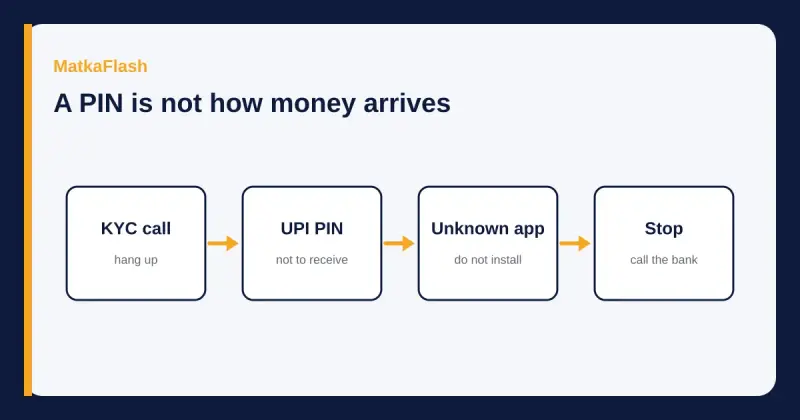 SafetyRisks that follow a betting app and a UPI paymentWhat the RBI's 28 January 2022 note says about KYC calls, unknown apps and a UPI PIN asked in order to receive money.8 min read
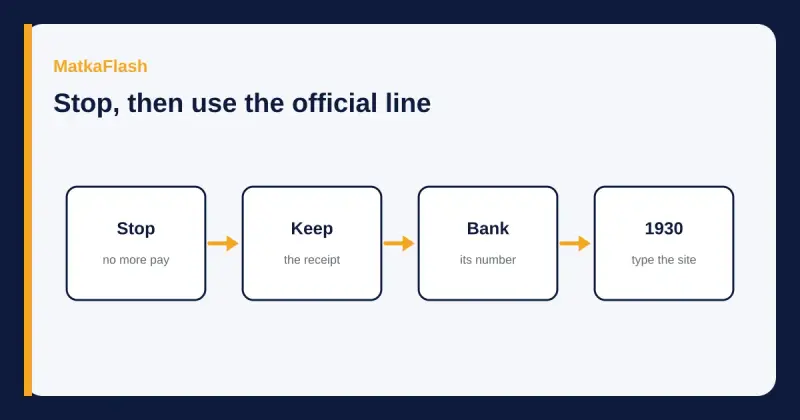 SafetyPaid a matka scammer? Prepare a fraud complaintKeep transaction evidence, contact your bank and find official cyber-fraud reporting channels. No recovery guarantees or further payments.8 min read