Stories
Why the game is called matka
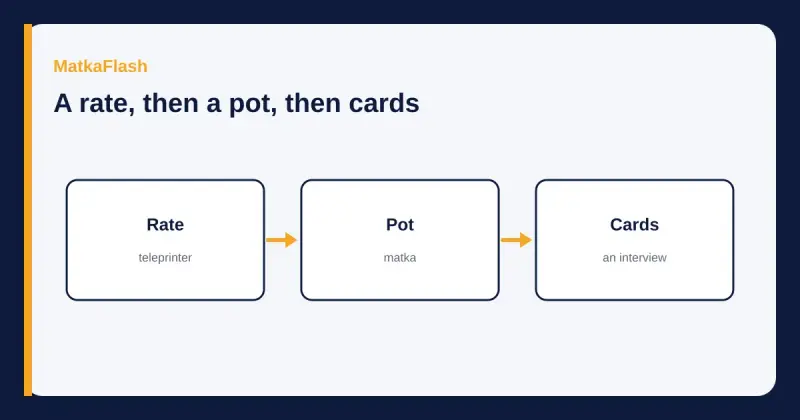
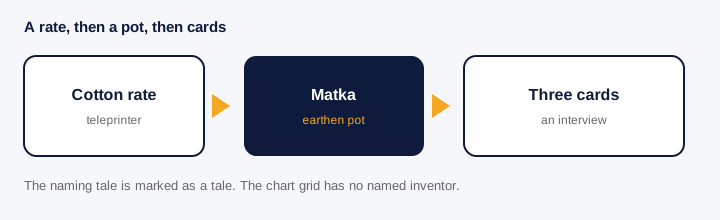
The papers use matka for an earthen pot, and for the draw that replaced a cotton rate on the weekend. They do not name an inventor of the modern chart grid.
Key points
- The 12 May 2020 Express report says the draw used chits in a pot because the New York market was shut at weekends.
- The 15 May 2020 Express Explained glosses matka as an earthen pot on a table beside a deck of cards.
- A story that Khatri named the game in front of reporters is printed as a tale Vivek Agarwal says he heard. The paper calls such tales apocryphal or otherwise.
- Vinod Bhagat, quoted there, describes a 12-figure card deck on 2 April 1962, and a 9-figure deck for Khatri. That is an interview, not a patent.
- No opened article names a person who invented the open-jodi-close grid used on results sites. This site does not invent that person.
Contents
The word is older than any page on this website, and younger than the cotton bets the papers describe. This chapter is only about the word and the draw. The spine of the series is who invented it. The two Mumbai names are in the Kalyan and Worli chapter. What a column means on MatkaFlash, including the digit-sum ank, is the glossary. That glossary is a recording rule. It is not a claim about 1962.
| Mechanism | Article | Limit |
|---|---|---|
| Cotton opening and closing rates, New York to Bombay, by teleprinter | Indian Express, 15 October 2018 | A news description of an old method |
| Chits drawn from a pot, because the New York market was shut on the weekend | Indian Express, 12 May 2020 | The papers reason for the pot. Not a rule for a modern cell |
| An earthen pot, called a matka, beside a deck of cards | Express Explained, 15 May 2020 | The papers gloss of the word |
| Twelve figures, queen and king as 11 and 12, jack left out, three cards a day, from 2 April 1962 | Same Explained, quoting Vinod Bhagat | A sons interview. Not a scanned deck |
| Nine figures, jack, queen and king removed | Same interview, about Khatri | The difference he describes. Not a payout table |
| Open, jodi, close, as a results grid | Not in these articles | This sites columns. No inventor is named, so none is printed |
A rate that arrived on a wire
The 15 October 2018 Express article says that in olden times the game was betting on the opening and closing rates of cotton, transmitted to the Bombay Cotton Exchange from the New York Cotton Exchange by teleprinters. The 12 May 2020 report places that cotton business with Kalyanji Bhagat in the 1960s, before the pot. A rate is a number that a market printed somewhere else. Waiting for it, the later interview says, had become unwieldy, and it happened only on five days a week. That sentence is Vinod Bhagat speaking to the Express Explained of 15 May 2020. It is the reason he gives for a card draw. It is not a transcript of the exchange.
The pot, and a tale the paper will not swear to
The 12 May 2020 report is plain. Khatri used the weekend closing of the New York Cotton Exchange. The matka he started involved drawing lots from chits in a pot. With telephones the number was passed across the country. The Express Explained of 15 May 2020, by Mohamed Thaver, puts an earthen pot on a table and calls it a matka, next to a deck of cards. That is the gloss this chapter relies on. Matka, in that sentence, is the pot.
The same article then tells a summer day in 1962: a man collects crime reporters, takes them to Zaveri Bazaar, has three of them pull cards from the pot, and announces that this form of gambling will henceforth be called matka. The paper does not print that scene as a file. It says the story was related by journalist Vivek Agarwal, who says he heard it from one of the journalists who went, nearly sixty years on, and that it is one of many tales, apocryphal or otherwise. A tale labelled that way is not upgraded here into a founding minute. The pot can be real in the 12 May report without the naming ceremony being a document.
What the son says was drawn
Vinod Bhagat, son of Kalyanji, told the Express Explained that on 2 April 1962 his father used a deck of twelve figures. The queen and the king stood for 11 and 12. The jack was not included. Three cards were drawn daily. Within a month, he said, it was famous as Worli matka because it operated from Vinod Mahal in Worli. People could bet from one rupee upward, on one number, on all three, or on the sum of the three. He said the Zaveri Bazaar market then asked for the draw, and his father franchised it to Rattan Khatri, with the name still Worli matka. Khatri, he said, used only nine figures, because jack, queen and king had been pulled from the deck.
Those are the mechanics in the interview. They are not the open panna, the jodi and the close panna on a MatkaFlash row. A three-card sum is not the same shape as 390-24-257. The glossary shows that stored Kalyan row and the digit-sum check this site uses. Searching the opened articles for a person who designed that grid does not produce a name. The Times of India page of 13 February 2019 prints a glossary of single, jodi and patti, and then says the paper claims no ownership of the content. A glossary with that disclaimer is not an origin story. This chapter leaves the inventor of the chart unnamed, because the sources leave the inventor unnamed.
A word is not a method
Calling a row a matka does not say what the next row will be. The cotton rate, the chit and the card are three reported ways a past number was chosen. Each of them was already chosen before anyone could read it. The guessing guide is the refusal to treat a past row as a due number. This page stops at the word.
Common questions
What does matka mean in the Express Explained?
An earthen pot. The 15 May 2020 article uses that gloss for the pot on the table beside the cards.
Did Ratan Khatri name the game in front of reporters in 1962?
The Express prints that scene as a story Vivek Agarwal says he heard decades later, and it calls such stories apocryphal or otherwise. This page does not treat it as a record.
Who invented the jodi and panna chart?
No article opened for this series names that person. The papers describe cotton rates, chits and cards. The open-jodi-close grid is how this site stores a result, not a 1962 patent.
Is a three-card sum the same as a jodi?
No. Vinod Bhagat describes bets on one card, on three cards, or on their sum. A jodi on this site is the open ank beside the close ank of a stored row.
Sources
- The Indian Express, What is Satta Matka, 15 October 2018indianexpress.com
- The Indian Express, Ratan Khatri dies at 88, 12 May 2020indianexpress.com
- The Indian Express Explained, 15 May 2020indianexpress.com
- Directorate General of Health Services, National Mental Health Programmedghs.mohfw.gov.in
Keep reading
 StoriesWho invented satta matka? The full storyThe press story of cotton rates, Kalyanji Bhagat in 1962, Ratan Khatri, a pot, and the 1990s. Reports, not a register.7 min read
 StoriesKalyan, Worli, and the Mumbai years in the pressWhat the Express and a 2020 Times of India interview report about Kalyanji Bhagat, Worli, and Ratan Khatri in Mumbai.7 min read
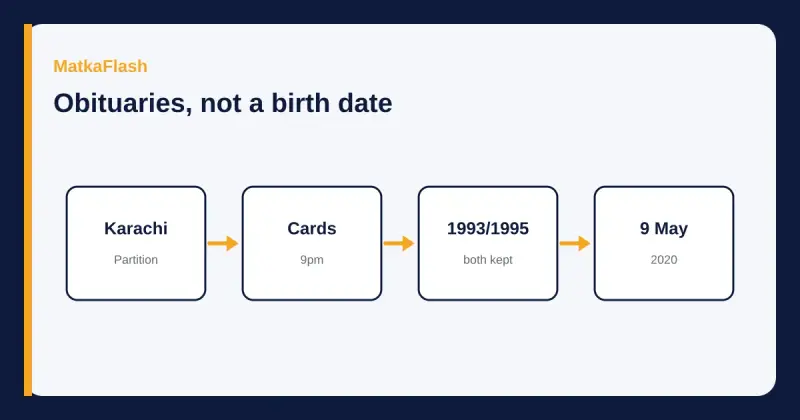 StoriesRatan Khatri, as the obituaries tell itWhat the May 2020 obituaries report about Ratan Khatri: Karachi, cotton, cards, jail, and two dates for when he stopped.7 min read
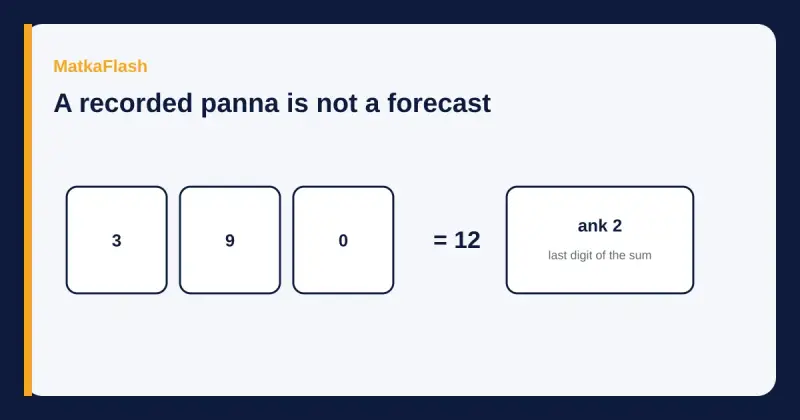 BasicsWhy guessing and fix ank do not workA matka chart records a draw that already happened. Fix ank lists and weekly jodis do not name the next independent draw.6 min read